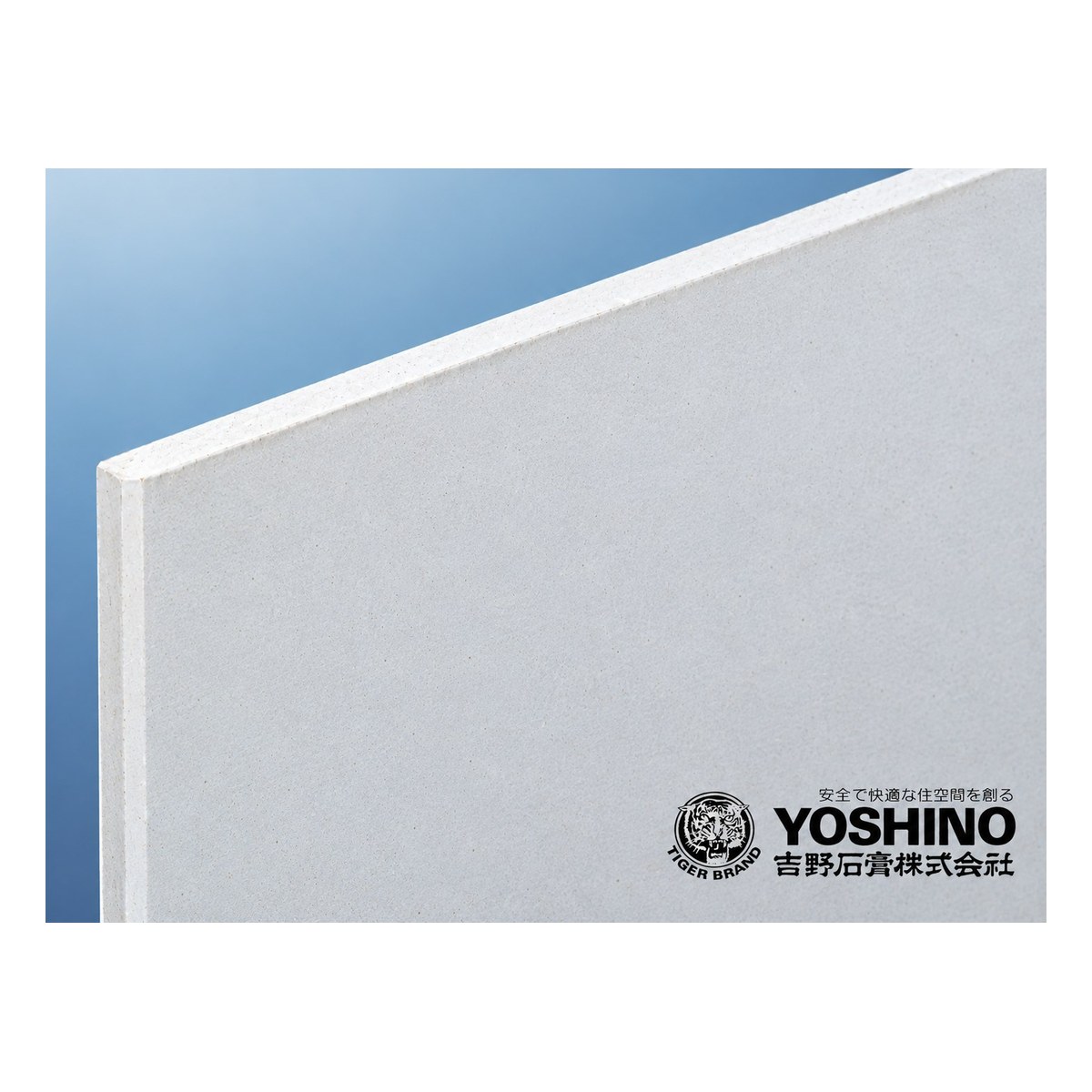
Key Advantages
-
Exceptionally high hardness: significantly improved surface resistance compared with standard plasterboard.
-
High mechanical strength: improved bending strength for handling loads and impacts.
-
Resistance to knocks and dents: suitable for high-traffic areas and intensive use.
-
Improved water resistance: reduced water absorption compared with standard plasterboard.
-
Non-combustible classification: Japanese approval NM-9645.
-
Acoustic improvement: suitable for use in dedicated wall and floor systems for noise insulation.
Varied finishing options: suitable for a painted finish with exposed joints, in accordance with the manufacturer’s guidelines.
Technical Data
| Property | Value |
|---|---|
| Manufacturing standard | JIS A 6901 |
| Thickness | 12.5 mm |
| Board dimensions | 91×182 cm |
| Board weight | Approx. 25 kg |
| Relative density | Approx. 1.2 |
| Compressive strength | Approx. 13 N/mm² (approx. 13 MPa) |
| Breaking load in bending | 950N / 470N, depending on the test direction |
| Dent depth in impact test | Approx. 0.3 mm |
| Total water absorption | Up to 10% |
| Surface water absorption | Up to 2 g |
| Japanese fire classification | NM-9645 – non-combustible |
Acoustic Performance in Floor Systems
Thanks to its high density, the board is suitable for use in acoustic floor systems designed to reduce impact noise.
The manufacturer’s catalogue presents a floor system comprising two layers of 12.5 mm Tiger Super Hard boards, combined with additional layers.
Test results for the complete system:
-
LH-59: heavy impact noise insulation rating.
-
LL-54: light impact noise insulation rating.
-
Fire resistance: 60 minutes according to Japanese regulatory requirements for the tested system.
The figures refer to the complete floor system and not to a single board.
Installation Guidelines
-
Cutting: it is recommended to use cutting tools suitable for hard boards, taking care to protect against dust.
-
Fixing: for direct installation on steel or timber framing, use Tiger SH screws according to the substrate type.
-
Single-layer installation: finish with exposed joints, in accordance with the manufacturer’s instructions.
-
Two-layer installation: joint treatment can be carried out when the board is installed over a base plasterboard layer, in accordance with the manufacturer’s specification.
-
Use in ceilings: the manufacturer does not permit installing the board in ceilings.
-
Exposure to water: do not install the board outdoors or in areas directly exposed to water. The board has improved resistance to water absorption, but it is not a board intended for direct, prolonged exposure to water.
Product Catalogue – Yoshino