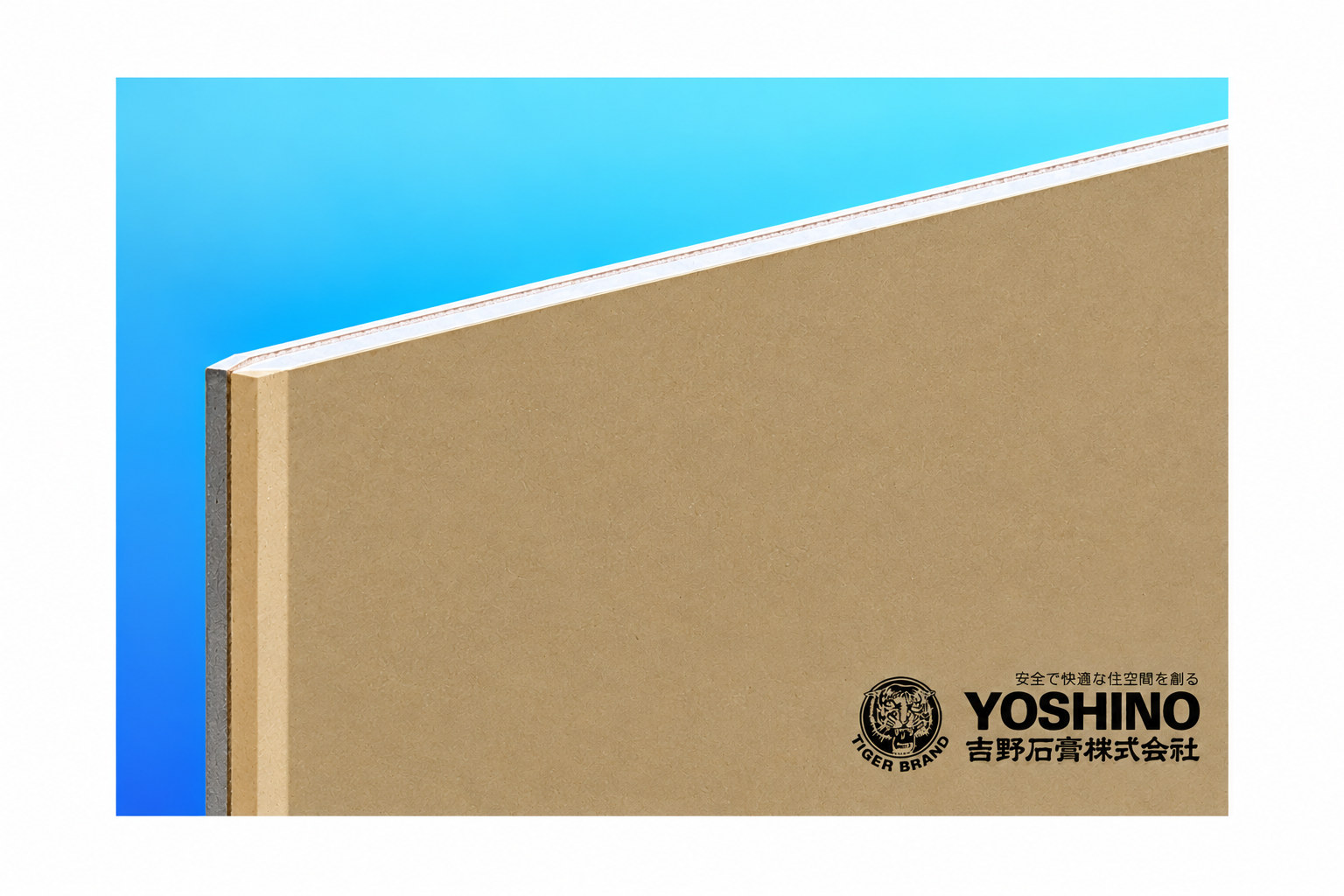
Key Advantages
-
Improved sound insulation: an addition of 5–10 decibels in testing of a defined wall system, depending on the installation configuration.
-
Vibration damping: an elastic adhesive layer between the gypsum boards helps reduce vibrations.
-
Multi-layer construction: a combination of a standard gypsum board and a fibre-reinforced hard gypsum board.
-
Upgrading existing walls: allows an acoustic insulation layer to be added without dismantling the original wall.
-
Minimal added thickness: total thickness of approx. 17 mm.
-
Japanese fire classification: QM-9074 approval as a building material with a flame-retardant (Quasi-Noncombustible) classification.
-
Compatibility with plasterboard systems: designed for use in interior construction systems in accordance with the manufacturer’s guidelines.
Technical Data
Property Value Total thickness 16.75 mm ± 0.5 mm Board dimensions 91×182 cm Board area approx. 1.66 m² Weight per m² 15 kg/m² ± 1.5 Calculated board weight approx. 24.8 kg Board construction standard gypsum board 9.5 mm + elastic layer 0.25 mm + hard gypsum board 7 mm Average relative density 0.90 ± 0.09 Moisture content up to 3% Breaking load in bending at least 500 N in the longitudinal direction Japanese fire classification QM-9074 – flame-retardant Acoustic Performance – Laboratory Data
In December 2016, Yoshino Gypsum (the manufacturer) published test results showing improved sound insulation of an existing plasterboard wall achieved by adding the panel.
Property Result Sound insulation rating of the original wall TLD 42 Improvement with the panel installed on one side 5 dB+ Wall rating after installation on one side TLD 47 Improvement with the panel installed on both sides 10 dB+ Wall rating after installation on both sides TLD 52 Test environment Yoshino Gypsum acoustic laboratory The test was carried out on a B15-G wall system, comprising metal framing, two layers of 15 mm reinforced gypsum board on each side and 50 mm glass wool in the wall cavity.
Good to know: the results relate to the wall system tested, and not to a single board. The actual improvement depends on the wall build-up, the continuity of the lining, the joint treatment and flanking sound paths.
Uses and Applications
The panel is designed for use in interior wall systems where improved sound insulation and vibration damping are required.
-
Interior walls and partitions: to improve sound insulation between rooms.
-
Upgrading existing walls: adding an acoustic insulation layer over existing plasterboard walls.
-
Children’s rooms and music rooms: to reduce noise transfer between spaces.
-
Living rooms and bedrooms: to improve privacy and acoustic comfort.
-
Areas with equipment and appliances: to damp vibrations and noise originating from equipment, such as washing machines.
Installation Guidelines and Key Notes
Installation on existing walls
The panel can be added as an additional layer over an existing plasterboard wall.
Continuity of the acoustic layer
Ensure full, continuous coverage of the wall. Partial installation, for example only above a suspended ceiling, is not expected to achieve the published test results.
Fire resistance
The panel carries the Japanese QM-9074 classification – flame-retardant. The classification relates to the board material and does not in itself indicate the fire-resistance duration of the wall system.
Exposure to water
The panel is intended for interior use. Protect it from moisture, high humidity and direct exposure to water.
Cutting and handling
When cutting or machining in ways that may generate dust, use dust extraction or suitable ventilation, a dust mask and protective equipment for the eyes and hands. Machining dust may contain crystalline silica.